


In programmatic advertising, even a seemingly harmless configuration can have a significant impact on revenue. One overlooked setting in Google Ad Manager can turn a standard House campaign into an unintended roadblock, preventing paid demand from competing for valuable impressions.
Publishers invest considerable effort into optimizing their advertising revenue. From improving viewability and adjusting floor prices to implementing header bidding and refining demand partner strategies, every optimization is intended to increase the value of available inventory.
However, some revenue losses have little to do with market conditions or demand quality. Instead, they originate from the ad server itself, often through settings that appear perfectly reasonable at first glance.
One such example is the "As many as possible" creative delivery setting in Google Ad Manager (GAM), particularly when applied to House line items.
When Fallback Advertising Becomes a Revenue Problem
House line items serve a straightforward purpose: filling advertising inventory that would otherwise remain unsold. Publishers commonly use them to promote their own products, services, newsletters, or internal campaigns.
Under normal circumstances, House campaigns have the lowest delivery priority in Google Ad Manager. As explained in Google's House line items documentation, they serve when no eligible higher-priority or monetizable demand is available.
The problem arises when a House line item containing multiple creatives is configured to display "As many as possible."
From a publisher's perspective, this option might seem intuitive. If a campaign is intended to prevent empty advertising placements, displaying as many creatives as possible sounds like a logical choice.
Unfortunately, the setting does not simply mean filling every available unsold placement independently. It introduces roadblocking behavior that can affect the allocation of other advertising slots on the same page.
How One House Impression Can Block Paid Demand
Roadblocking is a legitimate advertising functionality, typically used when an advertiser wants multiple creatives displayed together across different placements on a page.
For example, a premium advertiser might purchase a coordinated campaign that occupies several positions simultaneously. In that situation, roadblocking is intentional and commercially justified.
For House campaigns, however, it can create an entirely different outcome.
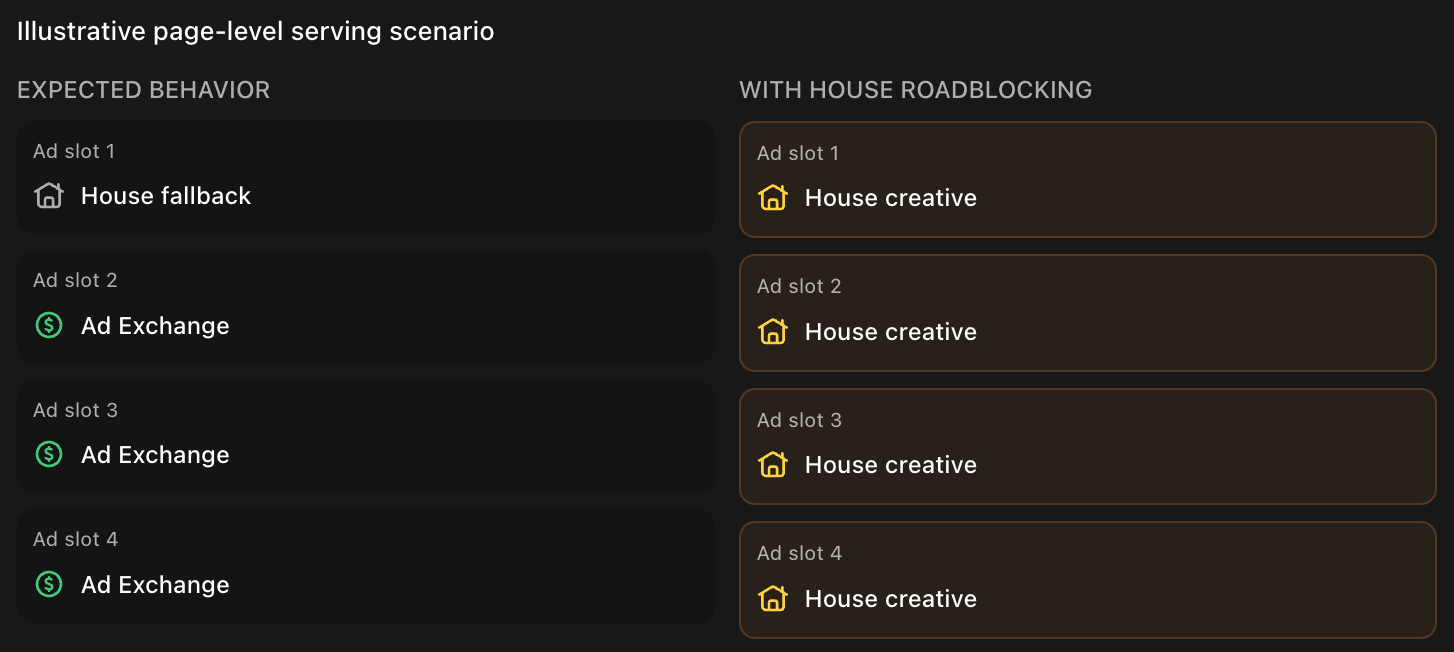
Consider a website with four advertising placements. The first placement receives no eligible Ad Exchange demand, so Google Ad Manager correctly selects a House creative.
Normally, the remaining three placements should continue evaluating their own eligible demand. But if the House line item is configured with "As many as possible," Ad Manager may attempt to deliver additional creatives from the same line item into subsequent matching placements.
| Ad placement | Expected delivery | With House roadblocking |
|---|---|---|
| Slot 1 | House (no paid demand) | House |
| Slot 2 | Ad Exchange ($2.50 CPM) | House |
| Slot 3 | Ad Exchange ($3.00 CPM) | House |
| Slot 4 | Ad Exchange ($2.00 CPM) | House |
| Paid impressions | 3 | 0 |
| Estimated revenue | $0.0075 | $0.00 |
Illustrative example using hypothetical Ad Exchange CPMs, assuming sufficient eligible House creatives and matching placements. Actual delivery depends on request sequencing, eligibility, and ad serving configuration.
The House campaign has effectively transformed from a fallback mechanism into a page-level roadblock.
Google explicitly describes this behavior in its official roadblocking documentation. When a lower-priority line item configured with "As many as possible" wins the first eligible placement, it can block subsequent slots even when higher-priority line items would otherwise be eligible.
Google's creative display documentation also explains how configurations that display multiple creatives together interact with Ad Exchange competition.
The critical issue is that a legitimate House impression in one slot can prevent other slots from generating revenue.
Why Publishers May Not Notice the Revenue Loss
From an analytics perspective, this issue is particularly problematic because it does not necessarily produce an obvious technical failure.
Advertising placements continue to display creatives. Fill rates may remain stable, and there are no visible empty spaces suggesting something is wrong.
Yet behind the scenes, the distribution of impressions between House campaigns and Ad Exchange may have changed significantly.
A publisher experiencing this issue could notice a decline in Ad Exchange impressions alongside an unexpected increase in House impressions, even though overall traffic and advertising requests remain relatively stable.
Without deeper investigation, such changes might be attributed to seasonal demand fluctuations, lower auction participation, or general market conditions.
The financial consequences can be meaningful.
Consider a publisher generating five million pageviews per month. If an average of 0.4 potentially monetizable impressions per pageview were displaced by unintended House delivery, the financial impact could look like this:
| Metric | Illustrative monthly value |
|---|---|
| Pageviews | 5,000,000 |
| Displaced impressions per pageview | 0.4 |
| Potentially lost Ad Exchange impressions | 2,000,000 |
| Assumed net Ad Exchange eCPM | $2.50 |
| Estimated monthly revenue opportunity | $5,000 |
| Annualized revenue opportunity | $60,000 |
This scenario assumes all displaced impressions could have been monetized at the specified eCPM. Actual losses depend on eligible paid demand, fill, and achievable revenue.
Even a relatively small serving inefficiency can create a substantial revenue impact when multiplied across millions of pageviews.


